Play It Again Sports Ping Pong Table
 Table lawn tennis at Liga Pro | |
| Highest governing torso | ITTF |
|---|---|
| First played | 19th century, England, Great britain[1] [ii] |
| Characteristics | |
| Contact | No |
| Team members | Singles or doubles |
| Type | Racquet sport, indoor |
| Equipment | Poly, 40 mm (one.57 in), 2.vii m (0.095 oz) |
| Glossary | Glossary of table tennis |
| Presence | |
| Olympic | Since 1988 |
| Paralympic | Since countdown 1960 Summer Paralympics |
Table tennis, also known as ping-pong and whiff-whaff, is a sport in which two or four players hit a lightweight brawl, also known as the ping-pong brawl, back and along across a table using small solid rackets. The game takes place on a difficult tabular array divided by a net. Except for the initial serve, the rules are mostly as follows: players must allow a ball played toward them to bounce once on their side of the tabular array and must return it then that it bounces on the contrary side at least once. A indicate is scored when a player fails to return the ball inside the rules. Play is fast and demands quick reactions. Spinning the brawl alters its trajectory and limits an opponent's options, giving the hitter a not bad advantage.
Table tennis is governed by the worldwide organization International Tabular array Lawn tennis Federation (ITTF), founded in 1926. ITTF currently includes 226 fellow member associations.[iii] The table tennis official rules are specified in the ITTF handbook.[4] Tabular array tennis has been an Olympic sport since 1988,[5] with several event categories. From 1988 until 2004, these were men's singles, women's singles, men's doubles and women's doubles. Since 2008, a squad upshot has been played instead of the doubles.
History

Parker Brothers Ping-Pong game
The sport originated in Victorian England, where it was played among the upper-course as an after-dinner parlour game.[1] [2] It has been suggested that makeshift versions of the game were developed by British war machine officers in Republic of india effectually the 1860s or 1870s, who brought it back with them.[6] A row of books stood upwardly along the centre of the table equally a internet, two more books served as rackets and were used to continuously hit a golf-ball.[7] [8]
The name "ping-pong" was in wide utilize before British manufacturer J. Jaques & Son Ltd trademarked it in 1901. The proper noun "ping-pong" and so came to describe the game played using the rather expensive Jaques's equipment, with other manufacturers calling information technology table lawn tennis. A similar situation arose in the Usa, where Jaques sold the rights to the "ping-pong" name to Parker Brothers. Parker Brothers then enforced its trademark for the term in the 1920s, making the various associations alter their names to "table tennis" instead of the more mutual, simply trademarked, term.[nine]
The side by side major innovation was by James Due west. Gibb, a British enthusiast of table lawn tennis, who discovered novelty celluloid balls on a trip to the US in 1901 and found them to be ideal for the game. This was followed by Due east.C. Goode who, in 1901, invented the modernistic version of the dissonance by fixing a sheet of pimpled, or stippled, rubber to the wooden blade. Tabular array tennis was growing in popularity past 1901 to the extent that tournaments were existence organized, books being written on the subject,[7] and an unofficial world championship was held in 1902. In those early on days, the scoring system was the same as in backyard lawn tennis.[10]
Although both a "Table Tennis Clan" and a "Ping Pong Association" existed past 1910,[ten] a new Table Tennis Association was founded in 1921, and renamed the English Table Lawn tennis Association in 1926.[eleven] The International Tabular array Tennis Federation (ITTF) followed in 1926.[one] [12] London hosted the first official Earth Championships in 1926. In 1933, the U.s.a. Table Tennis Association, now called USA Tabular array Tennis, was formed.[ane] [thirteen]
In the 1930s, Edgar Snow commented in Red Star Over Red china that the Communist forces in the Chinese Ceremonious State of war had a "passion for the English game of table tennis" which he constitute "bizarre".[xiv] On the other hand, the popularity of the sport waned in 1930s Soviet Spousal relationship, partly considering of the promotion of team and military sports, and partly because of a theory that the game had adverse wellness furnishings.[15]
In the 1950s, paddles that used a rubber canvass combined with an underlying sponge layer changed the game dramatically,[1] introducing greater spin and speed.[16] These were introduced to United kingdom of great britain and northern ireland by sports goods manufacturer S.Westward. Hancock Ltd. The apply of speed glue kickoff in the mid 1980s increased the spin and speed fifty-fifty farther, resulting in changes to the equipment to "slow the game down". Tabular array lawn tennis was introduced as an Olympic sport at the Olympics in 1988.[17]
Dominion changes
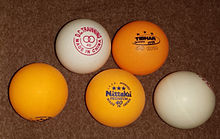
Assortment of 40 mm table tennis assurance
After the 2000 Olympics in Sydney, the ITTF instituted several dominion changes that were aimed at making tabular array tennis more feasible every bit a televised spectator sport.[18] [19] First, the older 38 mm (1.l in) balls were officially replaced past 40 mm (1.57 in) balls in October 2000.[7] [xx] This increased the brawl's air resistance and finer slowed down the game. By that time, players had begun increasing the thickness of the fast sponge layer on their paddles, which fabricated the game excessively fast and difficult to spotter on television. A few months later on, the ITTF inverse from a 21-indicate to an xi-signal scoring system (and the serve rotation was reduced from five points to two), constructive in September 2001.[7] This was intended to brand games more fast-paced and exciting. The ITTF also changed the rules on service to prevent a thespian from hiding the ball during service, in lodge to increase the average length of rallies and to reduce the server'due south advantage, effective in 2002.[21] For the opponent to have time to realize a serve is taking place, the ball must be tossed a minimum of 16 centimetres (6.iii in) in the air. The ITTF states that all events afterwards July 2014 are played with a new poly material ball.[22] [23]
Equipment
Ball
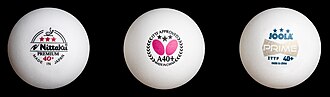
Tabular array Tennis Plastic Assurance 40+ mm with ITTF approval
The international rules specify that the game is played with a sphere having a mass of 2.7 grams (0.095 oz) and a diameter of 40 millimetres (one.57 in).[24] The rules say that the ball shall bounce up 24–26 cm (9.4–x.2 in) when dropped from a pinnacle of 30.5 cm (12.0 in) onto a standard steel block thereby having a coefficient of restitution of 0.89 to 0.92. As of 2015, balls are at present made of a polymer instead of celluloid, colored white or orange, with a matte finish. The choice of ball color is fabricated according to the tabular array colour and its environment. For case, a white ball is easier to encounter on a green or blueish table than it is on a grey table. Manufacturers oftentimes indicate the quality of the brawl with a star rating organization, ordinarily from one to three, three existence the highest class. Equally this organisation is non standard beyond manufacturers, the merely mode a ball may be used in official competition is upon ITTF approval[24] (the ITTF approval tin can be seen printed on the brawl).
The 40 mm brawl was introduced afterward the cease of the 2000 Summer Olympics; previously a 38 mm brawl was standard.[20] This created some controversies. Vladimir Samsonov, the World No. 1 table tennis professional person at the time, threatened to pull out of the Globe Cup, which was scheduled to debut the new regulation ball on 12 Oct 2000.[25]
Table

Diagram of a tabular array tennis table showing the official dimensions
The table is 2.74 thousand (9.0 ft) long, 1.525 m (5.0 ft) wide, and 76 cm (2.5 ft) loftier with any continuous textile so long as the table yields a uniform bounce of about 23 cm (ix.one in) when a standard ball is dropped onto it from a height of 30 cm (11.eight in), or near 77%.[26] [27] The table or playing surface is uniformly dark colored and matte, divided into two halves by a net at 15.25 cm (6.0 in) in elevation. The ITTF approves merely wooden tables or their derivates. Concrete tables with a steel cyberspace or a solid concrete sectionalization are sometimes bachelor in outside public spaces, such every bit parks.[28]
Playing expanse
ITTF regulations require a playing infinite of at least 14 chiliad (45.nine ft) long by seven 1000 (23.0 ft) wide, and a height clearance of at to the lowest degree v m (sixteen.4 ft).[29] For wheelchair events, the minimums are 8 m (26.ii ft) long and half-dozen m (19.7 ft) wide.[29]
Racket

India's Manika Batra hits the ball. She specialises in playing long-pimples on her backhand, a safety which is not often played by acme players.[30]
Players are equipped with a laminated wooden noise covered with rubber on 1 or two sides depending on the grip of the player. The ITTF uses the term "noise",[31] though "bat" is common in Britain, and "paddle" in the U.Due south. and Canada.
The wooden portion of the noise, often referred to as the "blade", commonly features anywhere betwixt one and seven plies of wood, though cork, drinking glass fiber, carbon fiber, aluminum fiber, and Kevlar are sometimes used. According to the ITTF regulations, at to the lowest degree 85% of the blade by thickness shall be of natural forest.[32] Mutual wood types include balsa, limba, cypress, and hinoki, which is popular in Nippon. The average size of the blade is about 17 centimetres (vi.7 in) long and 15 centimetres (5.9 in) broad. Although the official restrictions but focus on the flatness and rigidity of the blade itself, these dimensions are optimal for most play styles.
Table lawn tennis regulations permit dissimilar safe surfaces on each side of the racket.[33] Various types of surfaces provide various levels of spin or speed, and in some cases they nullify spin. For example, a histrion may take a rubber that provides much spin on 1 side of their dissonance, and one that provides no spin on the other. By flipping the racket in play, different types of returns are possible. To aid a histrion distinguish between the prophylactic used by his opposing player, international rules specify that one side must be black while the other side must exist a bright colour clearly distinguishable from blackness and from the color of the ball.[32] The thespian has the right to inspect their opponent'south racket before a match to see the type of rubber used and what color it is. Despite high-speed play and rapid exchanges, a histrion tin can come across clearly what side of the racket was used to hit the ball. Current rules land that, unless damaged in play, the racket cannot be exchanged for another racket at any fourth dimension during a lucifer.[34]
Gameplay
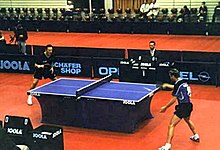
Starting a game
According to ITTF dominion ii.xiii.i, the first service is decided past lot,[35] normally a coin toss.[36] It is as well common for i histrion (or the umpire/scorer) to hibernate the ball in ane or the other hand, ordinarily subconscious under the table, allowing the other player to approximate which hand the ball is in. The correct or incorrect judge gives the "winner" the choice to choose to serve, receive, or to choose which side of the table to use. (A common simply not-sanctioned method is for the players to play the ball back and along three times and and then play out the bespeak. This is commonly referred to as "serve to play", "rally to serve", "play for serve", or "volley for serve".)
Service and render

In game play, the player serving the ball commences a play.[37] The server kickoff stands with the ball held on the open up palm of the manus not carrying the paddle, chosen the freehand, and tosses the ball directly upward without spin, at to the lowest degree 16 cm (6.3 in) high.[38] The server strikes the ball with the dissonance on the ball's descent so that information technology touches first his court and then touches straight the receiver'southward court without touching the internet assembly. In casual games, many players do not toss the ball upward; still, this is technically illegal and tin can requite the serving player an unfair advantage.
The ball must remain behind the endline and in a higher place the upper surface of the tabular array, known as the playing surface, at all times during the service. The server cannot utilize his/her body or vesture to obstruct sight of the ball; the opponent and the umpire must have a clear view of the ball at all times. If the umpire is doubtful of the legality of a service they may first interrupt play and give a warning to the server. If the serve is a clear failure or is doubted once more by the umpire afterwards the warning, the receiver scores a point.
If the service is "adept", then the receiver must make a "good" return by hitting the brawl back before it bounces a 2d time on receiver'due south side of the table so that the ball passes the net and touches the opponent'due south courtroom, either direct or subsequently touching the net assembly.[39] Thereafter, the server and receiver must alternately make a return until the rally is over. Returning the serve is one of the nigh difficult parts of the game, equally the server'due south beginning move is oft the to the lowest degree anticipated and thus nigh advantageous shot due to the numerous spin and speed choices at his or her disposal.
Let
A Allow is a rally of which the outcome is non scored, and is called in the following circumstances:[40]
- The ball touches the net in service (service), provided the service is otherwise correct or the ball is obstructed by the player on the receiving side. Obstruction means a role player touches the ball when it is above or traveling towards the playing surface, non having touched the player's court since terminal being struck by the player.
- When the actor on the receiving side is non set and the service is delivered.
- Player's failure to brand a service or a render or to comply with the Laws is due to a disturbance outside the control of the player.
- Play is interrupted by the umpire or assistant umpire.
A allow is also called foul service, if the ball hits the server's side of the table, if the brawl does not pass further than the border, and if the ball hits the table edge and hits the net.
Scoring
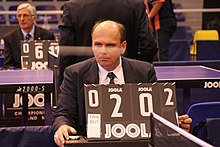
A point is scored by the player for any of several results of the rally:[41]
- The opponent fails to make a correct service or return.
- Subsequently making a service or a return, the brawl touches anything other than the internet assembly before beingness struck past the opponent.
- The ball passes over the player'south court or beyond their end line without touching their court, after being struck by the opponent.
- The opponent obstructs the brawl.
- The opponent strikes the brawl twice successively. Note that the hand that is belongings the noise counts as function of the racket and that making a practiced return off i's hand or fingers is allowed. It is not a fault if the brawl accidentally hits one's hand or fingers and then afterward hits the racket.
- The opponent strikes the ball with a side of the racket bract whose surface is not covered with rubber.
- The opponent moves the playing surface or touches the net associates.
- The opponent'due south complimentary paw touches the playing surface.
- Equally a receiver under the expedite organization, completing xiii returns in a rally.[42]
- The opponent that has been warned by the umpire commits a second offense in the same individual lucifer or team match. If the 3rd offence happens, 2 points volition be given to the player.[43] If the individual match or the team friction match has non ended, any unused penalty points can exist transferred to the next game of that match.[36]
A game shall exist won by the role player first scoring 11 points unless both players score x points, when the game shall exist won by the first player afterwards gaining a lead of 2 points. A match shall consist of the best of any odd number of games.[44] In competition play, matches are typically best of five or seven games.
Alternation of services and ends
Service alternates between opponents every ii points (regardless of winner of the rally) until the end of the game, unless both players score ten points or the expedite system is operated, when the sequences of serving and receiving stay the same but each player serves for merely ane point in turn (Deuce).[45] The player serving outset in a game receives first in the next game of the match.
Later each game, players switch sides of the tabular array. In the concluding possible game of a match, for example the 7th game in a all-time of 7 match, players change ends when the first player scores five points, regardless of whose turn information technology is to serve. If the sequence of serving and receiving is out of turn or the ends are not inverse, points scored in the wrong situation are even so calculated and the game shall be resumed with the order at the score that has been reached.
Doubles game

Service zone in doubles game

Service of a mixed doubles friction match
In addition to games betwixt individual players, pairs may also play table tennis. Singles and doubles are both played in international contest, including the Olympic Games since 1988 and the Commonwealth Games since 2002.[46]
In doubles, all the rules of single play are practical except for the post-obit.
Service
- A line painted forth the long axis of the table to create doubles courts bisects the tabular array. This line's only purpose is to facilitate the doubles service rule, which is that service must originate from the right hand "box" in such a mode that the kickoff bounce of the serve bounces one time in said right mitt box and then must bounce at least once in the opponent side's right hand box (far left box for server), or the receiving pair score a bespeak.[38]
Order of play, serving and receiving
- Players must hit the brawl in turn. For example, if A is paired with B and 10 is paired with Y, then A is the server and X is the receiver. and the order of play shall be A→X→B→Y. The rally gain this manner until i side fails to make a legal return and the other side scores.[47]
- At each alter of service, the previous receiver shall become the server and the partner of the previous server shall become the receiver. For case, if the previous club of play is A→X→B→Y, the order becomes X→B→Y→A subsequently the change of service.[45]
- In the second or the latter games of a match, the game begins in reverse gild of play. For example, if the social club of play is A→X→B→Y at kickoff of the first game, the order begins with X→A→Y→B or Y→B→X→A in the 2nd game depending on either Ten or Y beingness chosen as the offset server of the game. That ways the start receiver of the game is the player who served to the starting time server of the game in the preceding game. In each game of a doubles match, the pair having the right to serve first shall choose which of them will do so. The receiving pair, withal, can only choose in the start game of the match.
- When a pair reaches v points in the final game, the pairs must switch ends of the tabular array and change the receiver to reverse the order of play. For example, when the last club of play before a pair score 5 points in the final game is A→Ten→B→Y, the order after modify shall be A→Y→B→Ten if A all the same has the 2d serve. Otherwise, X is the next server and the order becomes X→A→Y→B.
Expedite system
If a game is unfinished after 10 minutes of play and fewer than 18 points have been scored, the expedite system is initiated.[42] The umpire interrupts the game, and the game resumes with players serving for one point in plough. If the expedite system is introduced while the ball is not in play, the previous receiver shall serve first. Nether the expedite system, the server must win the point before the opponent makes 13 sequent returns or the betoken goes to the opponent. The organization tin likewise exist initiated at any time at the request of both players or pairs. Once introduced, the expedite system remains in force until the finish of the match. A rule to shorten the fourth dimension of a match, it is mainly seen in defensive players' games.
Grips
Though tabular array tennis players grip their rackets in various means, their grips can exist classified into ii major families of styles, penhold and shakehand.[48] The rules of table tennis do not prescribe the manner in which 1 must grip the racket, and numerous grips are employed.
Penhold

An instance of a Penholder grip
The penhold grip is so-named because one grips the racket similarly to the manner i holds a writing instrument.[49] The mode of play among penhold players can vary profoundly from player to actor. The most pop style, usually referred to as the Chinese penhold fashion, involves curling the middle, ring, and fourth finger on the back of the blade with the 3 fingers always touching one some other.[49] Chinese penholders favour a round noise caput, for a more over-the-tabular array manner of play. In contrast, another style, sometimes referred to as the Japanese/Korean penhold grip, involves splaying those three fingers out across the back of the racket, usually with all three fingers touching the back of the dissonance, rather than stacked upon i another.[49] Sometimes a combination of the two styles occurs, wherein the eye, ring and fourth fingers are straight, but still stacked, or where all fingers may exist touching the back of the racket, just are also in contact with i some other. Japanese and Korean penholders will often utilize a square-headed racket for an away-from-the-table style of play. Traditionally these square-headed rackets feature a block of cork on top of the handle, as well as a thin layer of cork on the dorsum of the racket, for increased grip and condolement. Penhold styles are popular among players originating from East Asian countries such as Communist china, Nippon, South Korea, and Taiwan.
Traditionally, penhold players employ simply ane side of the racket to striking the ball during normal play, and the side which is in contact with the last iii fingers is generally not used. This configuration is sometimes referred to as "traditional penhold" and is more ordinarily found in square-headed noise styles. However, the Chinese developed a technique in the 1990s in which a penholder uses both sides of the dissonance to hit the ball, where the actor produces a backhand stroke (near often topspin) known as a reverse penhold backhand past turning the traditional side of the noise to face one's cocky, and striking the ball with the opposite side of the racket. This stroke has profoundly improved and strengthened the penhold mode both physically and psychologically, as it eliminates the strategic weakness of the traditional penhold backhand.
Shakehand

Forehand
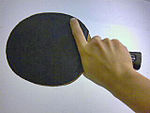
Backhand
The shakehand grip is and then-named because the racket is grasped as if i is performing a handshake.[50] Though it is sometimes referred to as the "tennis" or "Western" grip, information technology bears no relation to the Western tennis grip, which was popularized on the West Coast of the United States in which the dissonance is rotated ninety°, and played with the wrist turned so that on impact the knuckles face the target. In table tennis, "Western" refers to Western nations, for this is the grip that players native to Europe and the Americas take almost exclusively employed.
The shakehand grip'due south simplicity and versatility, coupled with the acceptance amidst top-level Chinese trainers that the European way of play should exist emulated and trained confronting, has established information technology as a common grip even in China.[51] Many globe-class European and E Asian players currently use the shakehand grip, and information technology is generally accustomed that shakehands is easier to learn than penholder, allowing a broader range of playing styles both offensive and defensive.[50]
Seemiller
The Seemiller grip is named after the American table tennis champion Danny Seemiller, who used it. It is achieved by placing the thumb and index finger on either side of the bottom of the racquet head and holding the handle with the rest of the fingers. Since only one side of the racquet is used to hit the ball, two contrasting rubber types can exist applied to the blade, offering the advantage of "twiddling" the racket to fool the opponent. Seemiller paired inverted rubber with anti-spin rubber. Many players today combine inverted and long-pipped rubber. The grip is considered exceptional for blocking, specially on the backhand side, and for forehand loops of backspin balls.[52] The Seemiller grip'south popularity reached its apex in 1985 when four (Danny Seemiller, Ricky Seemiller, Eric Boggan and Brian Masters) of the United States' five participants in the Globe Championships used it.[52]
Stance
'A skillful ready position will enable you to move rapidly into position and to stay balanced whilst playing powerful strokes.'[53]
The stance in table tennis is besides known as the 'ready position'. Information technology is the position every histrion initially adopts when receiving and returns to after playing a shot in guild to be prepared to brand the next shot. It involves the feet being spaced wider than shoulder width and a partial crouch being adopted; the hunker is an efficient posture for moving rapidly from and also preloads the muscles enabling a more than dynamic movement. The upper torso is positioned slightly forward and the player is looking forwards. The racket is held at the gear up with a bent arm. The position should experience balanced and provide a solid base of operations for hitting and quick lateral motion. Players may tailor their opinion based upon their personal preferences, and change it during the game based upon the specific circumstances.[54]
Types of strokes
Table lawn tennis strokes generally break down into offensive and defensive categories.
Offensive strokes
Hit
As well known every bit speed drive, a direct hit on the ball propelling it forrard back to the opponent. This stroke differs from speed drives in other noise sports like lawn tennis because the dissonance is primarily perpendicular to the direction of the stroke and nigh of the energy practical to the ball results in speed rather than spin, creating a shot that does not arc much, but is fast enough that it tin be hard to return. A speed drive is used more often than not for keeping the brawl in play, applying pressure on the opponent, and potentially opening up an opportunity for a more than powerful assault.
Loop
Perfected during the 1960s,[1] [55] the loop is essentially the reverse of the chop. The racket is parallel to the direction of the stroke ("airtight") and the racket thus grazes the ball, resulting in a large amount of topspin. A good loop bulldoze will arc quite a scrap, and once hitting the opponent's side of the table volition jump forward, much like a kick serve in tennis. About professional players nowadays, such as Ding Ning, Timo Boll and Zhang Jike, primarily utilise loop for offense.
Counter-hit
The counter-hit is usually a counterattack against drives, normally high loop drives. The dissonance is held closed and near to the brawl, which is hitting with a short motility "off the bounciness" (immediately afterward hit the table) so that the ball travels faster to the other side. Kenta Matsudaira is known for primarily using counter-hitting for offense.
Flip
When a role player tries to assail a brawl that has not bounced across the edge of the table, the player does not have the room to wind up in a backswing. The ball may nevertheless be attacked, withal, and the resulting shot is called a flip considering the backswing is compressed into a quick wrist action. A flip is not a single stroke and tin can resemble either a loop drive or a loop in its characteristics. What identifies the stroke is that the backswing is compressed into a curt wrist flick.
Smash
A player will typically execute a smash when the opponent has returned a ball that bounces as well high or too close to the net. It is almost always done with a forehand stroke. Smashing uses rapid acceleration to impart every bit much speed on the ball every bit possible so that the opponent cannot react in time. The dissonance is by and large perpendicular to the management of the stroke. Because the speed is the master aim of this shot, the spin on the ball is often minimal, although it tin be applied too. An offensive table tennis thespian will think of a rally as a build-up to a winning smash. Smash is used more than often with penhold grip.
Defensive strokes
Push
The push (or "slice" in Asia) is usually used for keeping the betoken alive and creating offensive opportunities. A push resembles a tennis slice: the dissonance cuts underneath the brawl, imparting backspin and causing the ball to float slowly to the other side of the tabular array. A push tin can be difficult to set on because the backspin on the ball causes it to drib toward the table upon striking the opponent'due south racket. In order to attack a push button, a player must usually loop (if the push button is long) or flip (if the push is short) the brawl back over the net. Often, the best option for beginners is to but push button the ball back once more, resulting in pushing rallies. Against good players, it may be the worst pick because the opponent will counter with a loop, putting the first histrion in a defensive position. Pushing tin have advantages in some circumstances, such every bit when the opponent makes like shooting fish in a barrel mistakes.
Chop
A chop is the defensive, backspin analogue to the offensive loop drive.[56] A chop is substantially a bigger, heavier button, taken well back from the table. The racket face points primarily horizontally, perhaps a little fleck upwards, and the direction of the stroke is straight down. The object of a defensive chop is to friction match the topspin of the opponent'due south shot with backspin. A good chop volition float nearly horizontally back to the tabular array, in some cases having and so much backspin that the ball actually rises. Such a chop can be extremely difficult to return due to its enormous amount of backspin. Some defensive players tin can also impart no-spin or sidespin variations of the chop. Some famous choppers include Joo Sae-hyuk and Wu Yang.
Cake
A cake is executed by simply placing the dissonance in front of the ball right after the ball bounces; thus, the ball rebounds back toward the opponent with nearly every bit much energy as it came in with. This requires precision, since the brawl'south spin, speed, and location all influence the correct angle of a block. It is very possible for an opponent to execute a perfect loop, drive, or smash, only to have the blocked shot come back just as fast. Due to the power involved in offensive strokes, ofttimes an opponent but cannot recover quickly enough to return the blocked shot, especially if the block is aimed at an unexpected side of the table. Blocks almost always produce the same spin as was received, many times topspin.
Lob
The defensive lob propels the ball well-nigh five metres in pinnacle, merely to land on the opponent's side of the tabular array with peachy amounts of spin.[57] The stroke itself consists of lifting the ball to an enormous peak earlier it falls back to the opponent's side of the table. A lob can accept nearly any kind of spin. Though the opponent may smash the ball difficult and fast, a good defensive lob could be more than difficult to return due to the unpredictability and heavy amounts of the spin on the ball.[57] Thus, though backed off the table by tens of anxiety and running to reach the ball, a adept defensive player can yet win the point using good lobs. The lob is used less oft by professional person players. A notable exception is Michael Maze.
Effects of spin
Calculation spin onto the ball causes major changes in table tennis gameplay. Although nearly every stroke or serve creates some kind of spin, understanding the private types of spin allows players to defend against and apply unlike spins effectively.[58]
Backspin
Backspin is where the bottom half of the ball is rotating away from the role player, and is imparted by striking the base of the ball with a downward move.[58] At the professional person level, backspin is commonly used defensively in order to proceed the ball low.[59] Backspin is ordinarily employed in service because it is harder to produce an offensive return, though at the professional level most people serve sidespin with either backspin or topspin. Due to the initial elevator of the brawl, in that location is a limit on how much speed with which one tin hit the ball without missing the opponent's side of the table. However, backspin besides makes it harder for the opponent to return the ball with great speed because of the required angular precision of the return. Alterations are ofttimes made to regulations regarding equipment in an endeavor to maintain a residuum between defensive and offensive spin choices.[ citation needed ] Information technology is actually possible to smash with backspin offensively, simply only on high balls that are close to the net.
Topspin
The topspin stroke has a smaller influence on the first part of the ball curve. Like the backspin stroke, withal, the axis of spin remains roughly perpendicular to the trajectory of the ball thus allowing for the Magnus effect to dictate the subsequent curvature. After the apex of the bend, the ball dips downward as it approaches the opposing side, earlier bouncing. On the bounciness, the topspin will advance the ball, much in the same way that a cycle which is already spinning would accelerate upon making contact with the ground. When the opponent attempts to return the ball, the topspin causes the ball to jump up and the opponent is forced to compensate for the topspin by adjusting the angle of his or her racket. This is known as "closing the noise".
The speed limitation of the topspin stroke is small compared to the backspin stroke. This stroke is the predominant technique used in professional competition considering it gives the opponent less time to reply. In tabular array tennis topspin is regarded every bit an offensive technique due to increased ball speed, lower bio-mechanical efficiency and the pressure that it puts on the opponent by reducing reaction time. (It is possible to play defensive topspin-lobs from far behind the tabular array, simply only highly skilled players use this stroke with any tactical efficiency.) Topspin is the least mutual type of spin to be plant in service at the professional level, simply considering it is much easier to assail a top-spin ball that is non moving at loftier speed.
Sidespin
This type of spin is predominantly employed during service, wherein the contact angle of the dissonance can be more than easily varied. Unlike the two same techniques, sidespin causes the ball to spin on an axis which is vertical, rather than horizontal. The axis of rotation is however roughly perpendicular to the trajectory of the ball. In this circumstance, the Magnus effect volition still dictate the curvature of the ball to some caste. Another difference is that, different backspin and topspin, sidespin will take relatively very footling event on the bounce of the ball, much in the same way that a spinning acme would not travel left or correct if its centrality of rotation were exactly vertical. This makes sidespin a useful weapon in service, considering it is less easily recognized when bouncing, and the ball "loses" less spin on the bounce. Sidespin tin can also be employed in offensive rally strokes, oft from a greater distance, as an adjunct to topspin or backspin. This stroke is sometimes referred to as a "hook". The hook can even be used in some extreme cases to circumvent the net when abroad from the table.
Corkspin
Players utilize this type of spin almost exclusively when serving, but at the professional level, it is also used from time to time in the lob. Dissimilar any of the techniques mentioned in a higher place, corkspin (or "drill-spin") has the centrality of spin relatively parallel to the brawl's trajectory, so that the Magnus effect has little or no result on the trajectory of a cork-spun brawl: upon bouncing, the ball volition sprint right or left (according to the direction of the spin), severely complicating the return. In theory, this type of spin produces the most obnoxious furnishings, only it is less strategically practical than sidespin or backspin, because of the limitations that it imposes upon the opponent during their return. Bated from the initial direction modify when bouncing, unless it goes out of reach, the opponent tin counter with either topspin or backspin. A backspin stroke is similar in the fact that the corkspin stroke has a lower maximum velocity, merely due to the contact angle of the dissonance when producing the stroke. To impart a spin on the ball which is parallel to its trajectory, the noise must be swung more or less perpendicular to the trajectory of the ball, greatly limiting the frontwards momentum that the noise transfers to the ball. Corkspin is most always mixed with another diversity of spin since solitary, it is not only less effective simply also harder to produce.
Competitions

A 2017 match between players from the United States and Democratic people's republic of korea.
Competitive table tennis is popular in East Asia and Europe, and has been[ vague ] gaining attention in the United States.[lx] The near important international competitions are the World Table Tennis Championships, the Table Tennis Globe Cup, the Olympics and the ITTF World Tour. Continental competitions include the following:
- European Championships
- Europe Top-16
- the Asian Championships
- the Asian Games
Chinese players have won sixty% of the men's World Championships since 1959;[61] in the women's competition for the Corbillin Loving cup, Chinese players have won all merely 3 of the World Championships since 1971.[62] Other strong teams come from East Asia and Europe, including countries such as Austria, Belarus, Germany, Hong Kong, Portugal, Nippon, Republic of korea, Singapore, Sweden, and Taiwan.[63]
There are professional competitions at the clubs level; the respective leagues of Austria, Belgium, China (Mainland china Table Tennis Super League), Nippon (T.League), France, Germany (Bundesliga), and Russia are examples of the highest level. There are also some important international club teams competitions such as the European Champions League and its former competitor,[ vague ] the European Gild Cup, where the top club teams from European countries compete.
Naturalization in table tennis

According to the New York Times, 31% of the table tennis players at the 2016 Summer Olympics were naturalized. The rate was twice equally high every bit the next sport, basketball game, which featured 15% of naturalized players.[64]
Feng Tianwei, a Chinese-born player representing Singapore, has medaled in iii Olympic table lawn tennis events, more than medals than native Singaporeans have won in all other sports combined (ii). These successes have been somewhat controversial in Singapore.[65] In 2014, Singapore Table Lawn tennis Association's president Lee Bee Wah quit over this issue;[66] her successor, Ellen Lee, later favored the application for citizenship of Zeng Jian, a China-born paddler.[67]
The rate of naturalization accelerated after the ITTF'south 2009 conclusion (one year afterward Cathay won every possible Olympic medal in the sport) to reduce the number of entries per clan in both the Olympics and the World Table Tennis Championships.[ citation needed ]
In 2019, the ITTF adopted new regulations which state that players who acquired a new nationality may non represent their new clan before:[68]
- 1 year later the date of registration, if the role player is under the age of xv when registered and has never represented another association
- 3 years afterwards the appointment of registration, if the player is under the historic period of 15 when registered and has already represented another association
- five years after the date of registration, if the actor is under the historic period of 18 but at least 15 years of historic period when registered
- 7 years afterward the date of registration, if the player is under the historic period of 21 but at to the lowest degree 18 years of age when registered
- 9 years after the date of registration, if the actor is at to the lowest degree 21 years erstwhile when registered
Notable players


An official hall of fame exists at the ITTF Museum.[73] A Grand Slam is earned past a player who wins singles crowns at the Olympic Games, Earth Championships, and World Cup.[74] Jan-Ove Waldner of Sweden first completed the grand slam at 1992 Olympic Games. Deng Yaping of China is the first female person recorded at the inaugural Women's Globe Cup in 1996. The post-obit tabular array presents an exhaustive list of all players to accept completed a k slam.
| Name | Gender | Nationality | Times won | |||
|---|---|---|---|---|---|---|
| Olympics | World Championships | World Cup | ||||
| January-Ove Waldner | Male |  Sweden Sweden | 1 (1992) | 2 (1989, 1997) | 1 (1990) | [75] |
| Deng Yaping | Female |  China China | 2 (1992, 1996) | iii (1991, 1995, 1997) | 1 (1996) | [76] |
| Liu Guoliang | Male | China | 1 (1996) | 1 (1999) | 1 (1996) | [77] |
| Wang Nan | Female | China | 1 (2000) | 3 (1999, 2001, 2003) | 4 (1997, 1998, 2003, 2007) | [78] |
| Kong Linghui | Male | Red china | 1 (2000) | 1 (1995) | 1 (1995) | [79] |
| Zhang Yining | Female | Communist china | 2 (2004, 2008) | two (2005, 2009) | iv (2001, 2002, 2004, 2005) | [80] |
| Zhang Jike | Male person | China | 1 (2012) | 2 (2011, 2013) | 2 (2011, 2014) | [81] |
| Li Xiaoxia | Female person | Mainland china | 1 (2012) | 1 (2013) | one (2008) | [82] |
| Ding Ning | Female | China | 1 (2016) | 3 (2011, 2015, 2017) | two (2011, 2014) | [83] |
| Ma Long | Male | China | 2 (2016, 2020) | iii (2015, 2017, 2019) | two (2012, 2015) | |
Jean-Philippe Gatien, Wang Hao and Fan Zhendong won both the World Championships and the World Cup, but lost in the gilt medal matches at the Olympics. Jörgen Persson also won the titles except the Olympic Games. Persson is one of the v table tennis players to accept competed at seven Olympic Games.[84] Ma Lin and Chen Meng won both the Olympic gilded and the World Cup, just lost in the finals of the World Championships.
Governance

Founded in 1926, the International Table Tennis Federation (ITTF) is the worldwide governing body for table tennis, which maintains an international ranking arrangement in addition to organizing events like the Earth Table Lawn tennis Championships.[xiii] In 2007, the governance for table lawn tennis for persons with a disability was transferred from the International Paralympic Committee to the ITTF.[85]
On many continents, there is a governing body responsible for table lawn tennis on that continent. For example, the European Table Tennis Matrimony (ETTU) is the governing torso responsible for tabular array lawn tennis in Europe.[86] There are too national bodies and other local authorities responsible for the sport, such every bit USA Table Tennis (USATT), which is the national governing body for tabular array lawn tennis in the United States.[13]
Variants
Hardbat table tennis uses rackets with short outward "pips" and no sponge, resulting in decreased speeds and reduced spin. World Championship of Ping Pong uses old-fashioned wooden paddles covered with sandpaper.
Round the World (likewise called Circular Robin or Circular the Table) tabular array tennis is an informal party-type variation in which players line up on either side of the table. When a player hits the brawl he sets the paddle downwards, and the player backside him picks information technology up to receive the return. When a player sets downward his paddle, he moves to the line at the opposing side of the table. Players are eliminated as they lose a betoken. When merely 2 players remain, a player hits the ball, sets his paddle down, spins and then retrieves his paddle to brand the return.[87] [88]
Come across besides
- Disability nomenclature in table tennis
- Glossary of table tennis
- International Table Tennis Federation
- List of ITTF Earth Tour winners
- List of table tennis players
- Beer pong
- Headis
- Ping-pong diplomacy
- Pingpongo
- Pong
- Table squash
References
- ^ a b c d e f Hodges 1993, p. 2
- ^ a b Letts, Greg. "A Cursory History of Tabular array Lawn tennis/Ping-Pong". Nearly.com. The New York Times Company. Archived from the original on 10 May 2011. Retrieved 29 August 2010.
- ^ "Fellow member Associations". ITTF. Archived from the original on seven August 2017. Retrieved 25 June 2017.
- ^ "ITTF Handbook". ITTF. Archived from the original on 20 Baronial 2021. Retrieved 20 Baronial 2021.
- ^ Hurt Iii, Harry (5 April 2008). "Ping-Pong every bit Mind Game (Although a Skillful Topspin Helps)". The New York Times. Archived from the original on nineteen June 2011. Retrieved 28 August 2010.
- ^ WashingtonPost.com. Accessed 2 August 2012.
- ^ a b c d "A Comprehensive History of Table Tennis". world wide web.ittf.com. ITTF. Archived from the original on thirteen March 2015. Retrieved 29 Baronial 2010.
- ^ Hamilton, Fiona (2 September 2008). "Inventors of ping-pong say Mayor Boris Johnson is wrong". The Times. Archived from the original on 8 January 2019. Retrieved 6 November 2010.
- ^ Dean R. Karau (August 2008). "Are There Whatever Trademark Rights Left In The Term Ping-Pong?". www.fredlaw.com. Fredrikson & Byron, P.A. Archived from the original on 30 May 2011.
- ^ a b Chisholm, Hugh, ed. (1911). . Encyclopædia Britannica. Vol. 21 (11th ed.). Cambridge University Press. p. 626.
- ^ M. Itoh (26 September 2011). The Origin of Ping-Pong Diplomacy: The Forgotten Builder of Sino-U.South. Rapprochement. p. 1. ISBN9780230339354.
- ^ "International Tabular array Tennis Federation Archives". www.ittf.com. ITTF. Archived from the original on 1 March 2011. Retrieved 29 August 2010.
- ^ a b c "About USATT". United States Olympic Committee. Archived from the original on 4 November 2010. Retrieved half dozen November 2010.
- ^ Edgar Snow, Red Star Over China, Grove Press, New York, 1938 (revised 1968), p 281.
- ^ "Отечественная История настольного тенниса". ttfr.ru. Archived from the original on 25 September 2015. Retrieved 24 September 2015.
- ^ "Thick Sponge Bats 1950s". www.ittf.com. ITTF. Archived from the original on 18 April 2010. Retrieved 29 August 2010.
- ^ "Table Tennis in the Olympic Games". www.ittf.com. ITTF. Archived from the original on 17 December 2007. Retrieved 29 August 2010.
- ^ Clemett, Colin. "Development of the Laws of Tabular array Lawn tennis and the Regulations for International Competitions" (PDF). ITTF Museum. ITTF. Archived from the original (PDF) on 31 March 2010. Retrieved 29 August 2010.
- ^ "Bigger ball after Olympics". New Straits Times. Malaysia. 24 February 2000. p. 39. Archived from the original on 22 December 2015. Retrieved 13 December 2015.
- ^ a b "Board of Directors Passes Use of 40mm Ball". U.s. Tabular array Tennis. Archived from the original on 19 June 2010. Retrieved 29 Baronial 2010.
- ^ "Sport takes plunge with new rule". New Straits Times. Malaysia. 27 April 2001. p. 40. Archived from the original on 22 December 2015. Retrieved 13 December 2015.
- ^ "BOARD OF DIRECTORS MEETING" (PDF). ITTF. Archived from the original (PDF) on 11 February 2014. Retrieved xiii October 2014.
- ^ "What Are the Origins of Table Tennis?". Archived from the original on 10 May 2011. Retrieved 29 August 2010.
- ^ a b "ITTF Technical Leaflet T3: The Ball" (PDF). ITTF. December 2009. p. 4. Archived from the original (PDF) on 4 March 2011. Retrieved 28 July 2010.
- ^ "Table tennis gets bigger ball". BBC Sport. Retrieved 22 July 2019.
- ^ International Table Tennis Federation 2011, alphabetize two.one
- ^ "ITTF Technical Leaflet T1: The Table" (PDF). ITTF. May 2013. Archived from the original (PDF) on 25 October 2013.
- ^ Kaminer, Ariel (27 March 2011). "The Joys of Ping-Pong in the Open". The New York Times. Archived from the original on i July 2017. Retrieved 23 February 2017.
- ^ a b "Handbook 2021" (PDF). International Table Lawn tennis Federation. Retrieved 6 December 2021.
- ^ "Manika'southward sleight of backhand gives India celebrated gold". ESPN. 8 April 2018. Retrieved 24 Baronial 2020.
- ^ 2013 ITTF Branding Guidelines Archived 28 Dec 2013 at the Wayback Machine Accessed 24 May 2014.
- ^ a b International Table Tennis Federation 2021, two.4 The Racket
- ^ "ITTF Technical Leaflet T4: Racket Coverings" (PDF). ITTF. August 2010. Archived from the original (PDF) on xiv December 2010. Retrieved 29 August 2010.
- ^ International Tabular array Tennis Federation 2011, index 3.4.2.iv
- ^ International Tabular array Tennis Federation 2011, alphabetize two.13.ane
- ^ a b "ITTF Handbook for Friction match Officials 13th edition" (PDF). ITTF. August 2007. Archived from the original (PDF) on five April 2012. Retrieved 1 September 2010.
- ^ International Table Tennis Federation 2011, index 2.v
- ^ a b International Tabular array Lawn tennis Federation 2011, alphabetize 2.half-dozen
- ^ International Table Tennis Federation 2011, index 2.7
- ^ International Table Tennis Federation 2011, index 2.5.three and 2.ix
- ^ International Tabular array Tennis Federation 2011, alphabetize two.5.iv and ii.10
- ^ a b International Table Tennis Federation 2011, index ii.fifteen
- ^ International Table Lawn tennis Federation 2011, index 3.5.2
- ^ International Tabular array Tennis Federation 2011, index two.11 and two.12
- ^ a b International Tabular array Tennis Federation 2011, index ii.xiii and 2.14
- ^ "ITTF statistics by event". ITTF. Archived from the original on 31 August 2010. Retrieved 1 September 2010.
- ^ International Table Lawn tennis Federation 2011, index 2.8
- ^ McAfee, Richard (2009). Table Tennis Steps to Success. Human Kinetics. p. one. ISBN978-0-7360-7731-6.
- ^ a b c Hodges 1993, p. thirteen
- ^ a b Hodges 1993, p. ten
- ^ Hodges; Yinghua. The Secrets of Chinese Tabular array Tennis.
- ^ a b Hodges, Larry. "Playing the Seemiller or American Grip". blog.paddlepalace.com. Archived from the original on thirty December 2014. Retrieved 1 December 2014.
- ^ Russell Moore (1 Oct 2010). "Coaching – Grip & Ready Position". Retrieved 12 October 2019.
- ^ Russell Moore (1 Oct 2010). "Coaching – Grip & Ready Position". Archived from the original on six November 2020. Retrieved 12 October 2019.
- ^ Hudetz, Radivoj (17 October 2017). "A History Lesson: How Topspin Revolutionized Table Tennis". Tabletennis11. Archived from the original on half-dozen March 2019. Retrieved 2 March 2019.
- ^ Hodges 1993, p. 89
- ^ a b Hodges 1993, p. 96
- ^ a b Hodges 1993, p. 20
- ^ Hodges 1993, p. 21
- ^ Somaiya, Ravi (26 November 2007). "Back-and-Forth Sport Is Back Again". The New York Times. Archived from the original on 1 July 2017. Retrieved 18 July 2016.
- ^ "World Championships Finalists - Men's Singles". ITTF. Archived from the original on sixteen June 2011. Retrieved 28 July 2010.
- ^ "World Championships Finalists - Women'south Singles". ITTF. Archived from the original on x August 2011. Retrieved 28 July 2010.
- ^ "ITTF Team Ranking". ITTF. Archived from the original on 11 April 2012. Retrieved 29 August 2010.
- ^ Keh, Andrew; Quealy, Kevin (eighteen August 2016). "At Least 44 Table Tennis Players in Rio Are Chinese-Born. Six Play for China". The New York Times . Retrieved 17 Feb 2020.
- ^ "What's next for Singapore on the international table lawn tennis sports scene?". Asean Today. eight November 2016. Retrieved 17 February 2020.
- ^ "Lee Bee Wah quits because of strange talent issues". The Independent. 17 August 2014. Retrieved 17 February 2020.
- ^ Chen, May (vii March 2017). "Table lawn tennis: STTA seeks Singapore passport for Zeng". The Straits Times . Retrieved 17 February 2020.
- ^ "Eligibility regulations in place effective from 3rdMay 2018–practical implementation" (PDF). ITTF. ane April 2019. Retrieved 17 Feb 2020.
- ^ "福原愛、石川佳純ほかメダル取った卓球選手のCM契約料は?". News Post Vii (in Japanese). 20 Baronial 2016. Retrieved 17 February 2020.
- ^ "最新アスリートCMギャラランキング". Friday (in Japanese). 13 January 2017. p. 63. Retrieved 17 February 2020.
- ^ "女性アスリート「CMギャラ」大坂なおみ1億円超の圧勝度". Wink (in Japanese). 27 April 2019. Retrieved 17 Feb 2020.
- ^ "引退アスリート「CMギャラ」元稀勢の里が1200万円で急上昇". Flash (in Japanese). 29 April 2019. Retrieved 17 February 2020.
- ^ "ITTF Hall of Fame" (PDF). www.ittf.com. ITTF. Archived from the original (PDF) on 27 February 2017. Retrieved 28 July 2010.
- ^ Cao Jianjie (thirteen December 2003). "Liu Guoliang needs to prove he is good as coach". ITTF. Archived from the original on 18 August 2017. Retrieved 27 August 2010.
- ^ "Jan-Ove Waldner's results of tournaments". ITTF. Archived from the original on 11 January 2017. Retrieved 27 Baronial 2010.
- ^ "Deng Yaping's results of tournaments". ITTF. Archived from the original on 26 November 2016. Retrieved 27 Baronial 2010.
- ^ "Liu Guoliang'due south results of tournaments". ITTF. Archived from the original on 26 November 2016. Retrieved 27 August 2010.
- ^ "Wang Nan'southward results of tournaments". ITTF. Archived from the original on 26 November 2016. Retrieved 27 Baronial 2010.
- ^ "Kong Linghui's results of tournaments". ITTF. Archived from the original on 26 November 2016. Retrieved 27 August 2010.
- ^ "Zhang Yining's results of tournaments". ITTF. Archived from the original on 26 Nov 2016. Retrieved 27 August 2010.
- ^ "Zhang Jike's results of tournaments". ITTF. Archived from the original on 26 Nov 2016. Retrieved 27 August 2010.
- ^ "Li Xiaoxia's results of tournaments". ITTF. Archived from the original on 26 November 2016. Retrieved 27 August 2010.
- ^ "Ding Ning's results of tournaments". ITTF. Archived from the original on 26 Nov 2016. Retrieved 11 Baronial 2016.
- ^ "Participations by athlete". Olympedia . Retrieved 7 December 2021.
- ^ "The ITTF Classification Lawmaking" (PDF). ITTF. Archived (PDF) from the original on ten September 2012. Retrieved half dozen September 2012.
- ^ "ETTU - European Table Tennis Marriage". European Table Lawn tennis Union. Archived from the original on 21 September 2010. Retrieved 28 August 2010.
- ^ "Ping Pong Variations." serenityhealth.com. Retrieved 17 March 2021.
- ^ "Around the World Ping Pong." partygames411.com. Retrieved 17 March 2021.
Bibliography
- Uzorinac, Zdenko (2001). ITTF 1926 - 2001 Table Tennis Legends. ITTF. ISBN2-94031-200-1. OCLC 248920627.
- Charyn, Jerome (2002). Sizzling Chops & Devilish Spins: Ping-Pong and the Art of Staying Alive. Four Walls 8 Windows. ISBNane-56858-242-0.
- Hodges, Larry (1993). Table Tennis: Steps to Success. Human Kinetics. ISBN0-87322-403-5.
- International Tabular array Tennis Federation (2011). ITTF Handbook 2011/2012. Archived from the original on 6 July 2010. Retrieved 25 Dec 2011.
- International Table Tennis Federation (2021). 2021 ITTF Handbook . Retrieved 7 December 2021.
- Seemiller, Dan (1996). Winning Table Lawn tennis: Skills, Drills, and Strategies. Human being Kinetics. ISBN0-88011-520-3.
External links
- Official ITTF website
- Official ETTU website
Source: https://en.wikipedia.org/wiki/Table_tennis
0 Response to "Play It Again Sports Ping Pong Table"
Post a Comment