A ______________ Is Used to Verify the Zero Reading on Micrometers Over One Inch
A Complete Guide to Micrometers
Acquire how to calibrate and use micrometers correctly in our comprehensive guide.

What is a Micrometer?
Micrometers (otherwise known as micrometer screw gauges) are essential measurement tools used by mechanical engineers, machinists and workers in other technical trades. They enable workers to accept extremely fine measurements, which may be displayed in either imperial or metric formats.
Micrometers allow for a greater degree of measuring accurateness than alternative tools, such as dial calipers and vernier calipers. They are available in digital, punch, and vernier styles. The term 'micrometer' tin be traced back to neoclassical Greece and literally translates as 'small measure.'
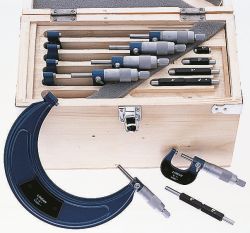
Dissimilar types of micrometers have measuring ranges of between 25mm and ane inch. This translates to the incremental metric measurements of 0-25mm, 25-50mm, fifty-75mm and so on. The imperial versions are equal to 0-1 inches, i-2 inches, ii-3 inches etc. Boxed micrometer sets can also be used for the purpose of taking micrometer readings beyond a wide range of sizes.
Micrometer Components
In order to sympathise how a micrometer works, you lot should first consider the primal components of the tool. Analysis of the components should besides further your agreement of how to read a micrometer.
Frame
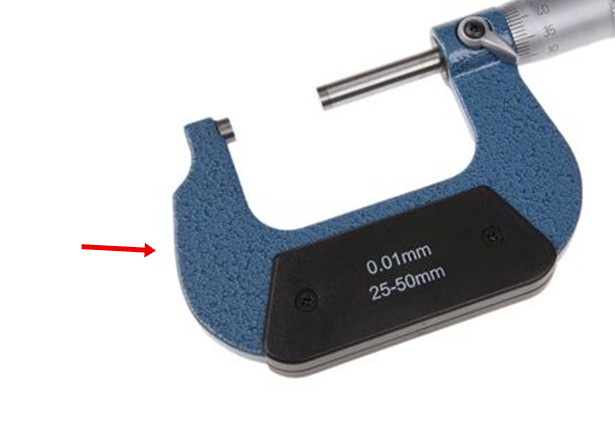
Micrometer frames are c-shaped and ensure the optimum positioning of the anvil and barrel. Frames may take a diversity of shapes and sizes, allowing for desirable functionality of the micrometer. The hub-shaped frame is platonic for taking highly accurate measurements in confined spaces.
Anvil
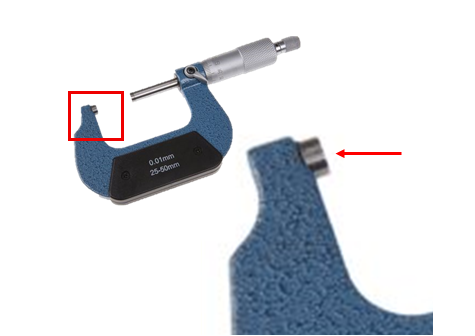
The micrometer anvil should exist noticeably shiny. It should ensure that the spindle gravitates towards the object, which is firmly secured. The anvil will be kept in consistent contact with the role and may chip unless a high level of care is taken. Quality models typically come complete with carbide-tipped micrometer anvils, which allow for an extended tool-life.
Sleeve or Barrel
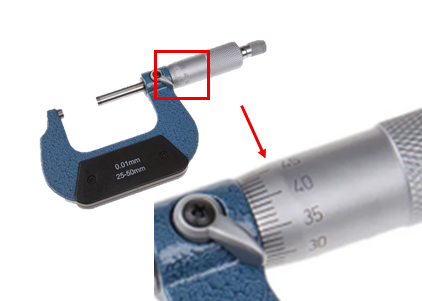
The round micrometer sleeve or barrel is kept securely in identify and features the linear scale. It is likewise quite mutual for vernier markings to be establish on this part of the micrometer. This scale allows highly accurate measurements to be taken in degrees of .0001.
Locking Nut
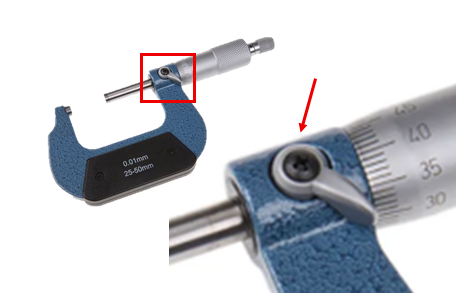
The spindle micrometer locking nut is a peculiarly helpful feature when it comes to maintaining sensation of the measurement and securing the spindle for minor lot gauging. Some micrometers come complete with lock nuts, while others have locking levers. Where possible, it is advisable to cull the locking lever multifariousness due to the relative ease of apply and maintenance.
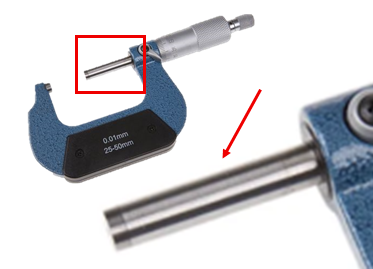
Spindle
Situated side by side to the measuring faces, the micrometer spindle is projected towards the anvil as a directly result of contact with the thimble.
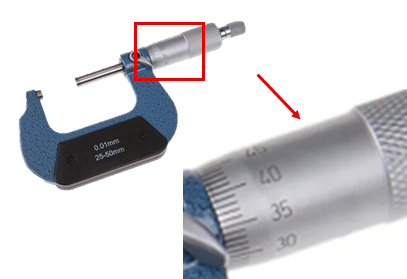
Thimble
You should gently employ pressure from the thumb in order to turn the micrometer thimble. This role features graduated markings, which should be easy to read.
Ratchet Stop
The micrometer ratchet stop can be plant on the terminate of the handle and it restricts the corporeality of pressure past enabling movement at a calibrated torque.

How Does a Micrometer Work?
Micrometers characteristic a calibrated screw, or thread, which is located within the spindle and allows for the device'south exceptional levels of measuring accuracy. The screw within the micrometer is used for the conversion of particularly pocket-sized distances for measurement. The spindle can be moved by turning the ratchet knob or thimble until there is light contact between the spindle and anvil. Each 360-degree turn of the spindle has the effect of adjusting the space betwixt the measuring displays by 0.05 in metric and 0.025 inches in imperial.
The thread pitch of the needle has a direct bearing on the level of measuring precision. The spindle is auto-screwed to a very loftier level of accuracy, with the object being measured positioned directly between the spindle and anvil. Some micrometers characteristic differential screws, which permit for particularly cracking levels of measuring accurateness.
It is highly of import to maintain the stability of whatever object that you are measuring with a micrometer. The object should be kept parallel to the anvils and a consistent level of pressure should be applied when taking the measurement.
The integrated ratchet thimble will ensure a high level of measuring accuracy, with this primal part functioning as an integrated torque wrench. The process should go along with the turning of the ratchet handle until a repeated clicking is heard. This will provide the assurance of taking the measurement with a consequent level of torque.
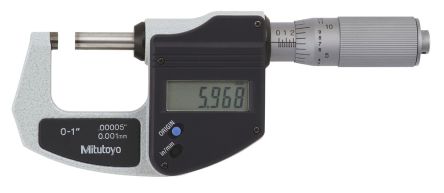
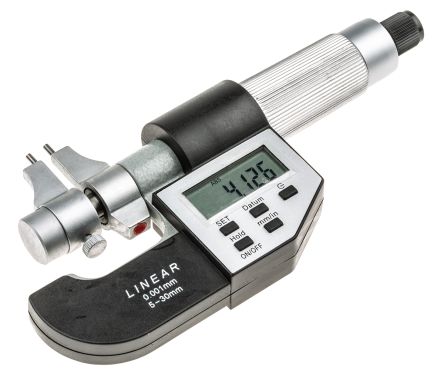
Digital micrometers feature electrical circuits, which permit for digital measurement and uncommonly authentic readings. The measurement will be displayed clearly on the LCD screen.
Why Utilise a Micrometer?
Micrometers are specially designed for the measurement of very small objects. They allow for the highly precise measurement of whatever item that fits between the anvil and spindle. Standard types of micrometers can be used for the fine measurement of items under one inch in length, depth, and thickness. However, there are some avant-garde models that let more precise measurements to exist taken. There is likewise the option of investing in anvil micrometers for the measurement of diversely shaped and sized objects. Portability, ease of use, and measuring consistency are just a few of the key micrometer advantages.
Types of Micrometer
There are diverse unlike types of micrometer bachelor, each suited to varying uses and applications. Exterior micrometers are ane of the most widely used varieties, but inside and depth micrometers are alternatives which may be more appropriate for utilise in certain scenarios. Below are some of the virtually common types of micrometers:
Ball Micrometers
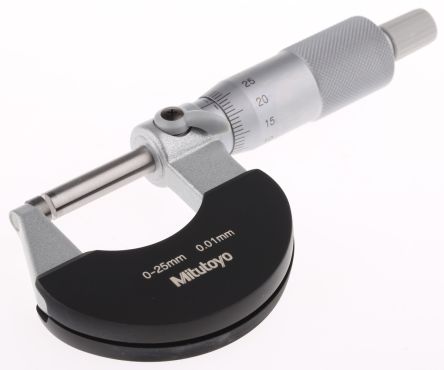
Brawl micrometers accept spherical anvils. They are used for purposes such as measuring the thickness of walls and establishing the distances between holes and edges. As opposed to tube micrometers, the ball variety can be used to correctly identify the measurement of culling rounded surfaces.
Digital Micrometers
Integrated with decoders for the effective identification of distance, these micrometers present measurements in a digital format.
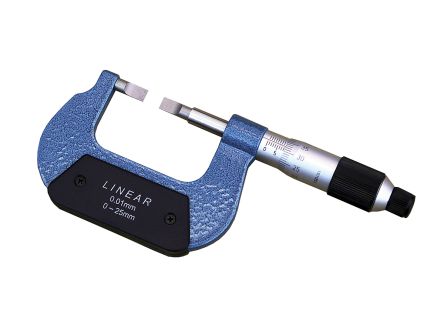
Blade Micrometers
This type of micrometer comes complete with matching narrow tips, or blades.They are particularly helpful when information technology comes to the measurement of specifically shaped objects, such as those with O-ring grooves.
Tube Micrometers
Designed to measure the thickness of tubes, tube micrometers feature cylindrical anvils which are located perpendicular to the spindle. They allow for quick and accurate measurements when compared with alternative tools.
Other Types of Micrometer
Universal Micrometers
These come up complete with interchangeable anvils, which may be flat, spherical, spline, deejay, blade, indicate, or knife edge. You lot may be expected to use universal micrometers featuring modular components, which permit for outside, mic depth, or alternative functionality.
Pitch Micrometers
Otherwise known every bit the thread mic, this tool features a specially designed fix of thread-shaped tips for successful identification of the screw thread diameter.
Limit Micrometers
Particularly well suited to measuring the thickness of tubes, micrometer limit mics come up complete with two anvils and two spindles, functioning as effective snap gauges. The gaps correspond directly to the upper and lower tolerance levels.
Diameter Micrometers
Commonly featuring a three-anvil head in combination with a solid base of operations, bore micrometers are ideally suited to the accurate measurement of inside diameters. They are specially helpful when information technology comes to the measurement of objects situated around machine fluids and coolants.
Bench Micrometers
Demote micrometers offering extremely high levels of accurateness and are typically used during workplace inspections. They allow for measurement up to somewhere in the region of 20 millionths of an inch, with a repeatability of around a quarter of a millimetre.
V Micrometers
Purpose-made for external measurement, Five micrometers come complete with small V-blocks for the anvil. They are ideally suited to the measurement of circumvolve diameter, with equidistant separation of 3 points. This allows for the effective measurement of iii-flute finish-mills and twist drills.
How to Read a Micrometer
Micrometers are the ideal tool for the measurement of cylindrical and spherical shaped objects. In order to use a micrometer, you should follow these steps:
-
Accept time to acquaint yourself with the principal technical terms
-
Clean the micrometer, using a soft cloth to remove any marks and debris from betwixt the anvil and spindle
-
Begin by positioning the item beingness measured next to the anvil. It is important to go on the object stable and avoid whatever scratching. Yous may control the micrometer with your gratis hand, or alternatively, there is the option of using a stationary vise, leaving both of your hands complimentary for command of the micrometer
-
Spin the ratchet anti-clockwise, ensuring that the 0 mark on the thimble is positioned in accord with the sleeve scale. Keep twisting until the spindle is inside close contact of the object; three clicks is a good guide
-
The thimble lock should be applied while the micrometer is within close proximity of the object. It should be possible to adjust the spindle equally required. Once you lot are confident that the micrometer has fulfilled its function you tin can remove the object, taking care to avoid scratching the anvil and spindle surfaces
-
Finally, record the reading, ensuring that the spindle is kept stable
The post-obit sections will requite yous more than information on how to read specific types of micrometers:
Metric Micrometer
When using a metric micrometer, It is necessary to acquaint yourself with the number scales that are displayed on the micrometer thimbles. Information technology is common for the acme line of the sleeve to feature millimetres, with the line below that featuring half millimetres.
The reading of the metric micrometer should begin with recording the number of millimetres. An initial reading of 7 would stand for to 7mm. Each half mark on the thimble should be taken into account. This means advisedly reading the lower bar and correctly identifying the corresponding number of 0.01mm.
Vernier Micrometer
Using a micrometer integrated with the vernier scale, the reading should be taken from the sleeve index line. This allows for precise readings, within 0.001mm. The initial reading should be taken from the sleeve. The measurements are likely to exist featured in intervals of 0.25 millimetres or 0.025 inches.
The next step is to take the reading from the thimble. These measurements are probable to be featured in 0.one millimetre or 0.01-inch intervals. The last reading should be taken from the vernier scale, which you volition find on the sleeve, straight adjacent to the first prepare of graduations.
The vernier micrometer reading is displayed in the format of 0.001 mm or 0.0001 inches, establishing the size of the object with farthermost accurateness.
You should be aware that fluctuations in temperature are likely to adversely touch on the micrometer reading. Call up not to keep your micrometer in your pocket or within a working environment with excessive heat levels.
Customary or Imperial Micrometer
The spindle of an royal micrometer features graduated levels of 40 threads per inch. Each plough results in movement of the spindle around an axis of 0.0025 inches, which equates to the expanse between adjacent graduations on the sleeve.
There are 25 graduations on the thimble, pregnant that the measurements can be divided the corresponding number of times. The visible reading corresponds directly to the number of whole divisions that are featured on the sleeve calibration, multiplied by 25. This means that the resulting bore is displayed in thousandths of an inch.
Micrometer Measurement Conversions
This section details how to convert your micrometer issue into another measurement unit of measurement.
Micrometers to mm
The quickest and easiest style to catechumen micrometers (um) to millimetres is to split up by yard. An alternative method is to move the decimal point 3 units to the left of the original figure.
Micrometers to inches
At that place are 25,400 micrometers to every inch, with i metre being equivalent to 1,000,000 micrometers. You lot should also be aware that each micrometer equals 3.9×10e-5 (with due east meaning to the power of).
Micrometers to cm
1um is equivalent to 0.0001cm (otherwise written as10e-iv).
How to Calibrate a Micrometer
To brand sure that your micrometer returns accurate data, you will demand to ensure that your tool is kept calibrated.
How Practice I Test if My Micrometer Needs Calibrating?
Standard 1-inch micrometers have readout divisions of 0.001 inch and an accuracy level of ±0.0001 inch. All the same, you must ensure that both the micrometer and the object existence measured are at room temperature for this high level of accuracy.
The micrometer reading test will involve the measurement of guide blocks in order to ascertain the desirable accurateness. If such a gauge cake is known to exist 0.75000 ±0.00005inch then the micrometer should give a reading of 0.7500 inch. If the respective measurement is 0.7503 or more than, and so the micrometer will be deemed to be out of calibration.
If you want to avoid such scale problems and then you must accept an infrequent level of care, advisedly cleaning, using, and storing the micrometer for continued use. It might be necessary to perform micrometer adjustment and recalibration in some instances. However, adjustment won't be sufficient when it comes to correcting issues such every bit the micrometer being misshapen or of the wrong size. Repair will be necessary for such instances.
Calibrating A Micrometer
The following steps explicate how to calibrate a micrometer and adjust it to aught.
-
Earlier proceeding to calibration, it is necessary to ensure that the tool is working effectively and that there aren't whatsoever bounden or related bug. You should clean the anvils and make certain that the reading is set to zilch
-
The side by side stride will be to cheque the micrometer at a range of examination points using gauge blocks or alternative standards with high levels of accuracy. A diversity of readings should exist taken at each test point. The tolerance level of the particular micrometer should be taken into account when writing down the readings
-
It is highly likely that your micrometer features a modest pin spanner. This should allow for the turning of the sleeve in relation to the barrel, ensuring the optimum repositioning of the zero line in relation to the thimble markings
-
You can expect to notice a small hole in the sleeve, designed for acceptance of the spanner'south pin. In following this calibration process, you will have the assurance of fugitive the not-aught error, which may otherwise occur when the jaws are close. You are advised to echo the zeroing process a few times for the assurance of micrometer accurateness
FAQs
What is a Nil Error?
If the zero mark on the thimble does not correspond with the datum line on the main calibration so there will be a nothing error. The reading on the main scale should also equal zero.
What is the Difference Between Micron and Micrometer?
The micron is a measurement of 1-millionth of a metre, while the micrometer is a measuring tool featuring a calibrated screw.
What is Micrometer Accurateness?
Micrometer accuracy may be considered in relation to two primal factors - the accuracy of the screw thread (or digital scale), and whatever process errors. The expected accurateness of a micrometer as established using the Vernier scale is 0.01mm.
What is the Departure Between a Micrometer and a Caliper?
Micrometers and Vernier calipers are both unremarkably used to constitute the sizes of different objects. Nonetheless, there is some contrast between the efficiency and usage of each of these tools. Calipers might be used to establish concrete dimensions, interior measurements, exterior measurements and depths. However, micrometers are generally used for more than specific purposes such as measuring exterior or inside dimensions. The expected accuracy of Vernier calipers is typically betwixt ±0.001, with the accuracy of micrometers generally being ±0.00005.
For more data, check out our complete guide to calipers.
What is the To the lowest degree Count of Micrometer?
The to the lowest degree count of a manually operated micrometer is 0.01mm. The least count of a digital micrometer is 0.001mm.
What is the Symbol for Micrometer?
The micrometer symbol as used by the International Agency of Weights and Measures is μm. The micrometer is an SI derived unit of length which equals one×10−6 metre (SI standard prefix "micro-" = 10−six), equivalent to one-millionth of a metre or one-thousandth of a millimetre.
Which is Bigger, Nano or Micro?
1 micro is equivalent to 1,000 nanos.
Pop Brands
Source: https://uk.rs-online.com/web/generalDisplay.html?id=ideas-and-advice/micrometers-guide
0 Response to "A ______________ Is Used to Verify the Zero Reading on Micrometers Over One Inch"
Post a Comment